00 /US market entry · wine & spirits
Most US market entries fail in predictable ways. Predictable is preventable.
I advise wine and spirits producers, wherever they are from, on one market only: the United States. Price built backwards from the shelf. The distributor matched to your real volume. A first year managed, not hoped for. I work this trade from every side of the table, producer, importer, distributor-facing sales, and Paris retail, in both languages.
It starts with a form, not a meeting. Before we speak you get a written diagnostic of where your price lands on a US shelf. I prepare it myself, it costs nothing, and it binds you to nothing.
01 /The three predictable failures
Pricing built in the wrong direction
A US shelf price is decided three margins before the shelf. Price forwards from your cellar and you discover your position by accident. It has to be built backwards, from the shelf your name can win, down through retailer, distributor, and importer margins, to an that survives the trip.
The wrong distributor
The right distributor for 2,000 cases is the wrong one for 200. A decade of consolidation has made the difference starker. In a giant’s book a mid-size brand is a rounding error, and in some states the law makes a bad signature nearly permanent.
A launch with no year one
Placement is not presence. If nobody reads the , works the reorders, and walks the accounts, the listing quietly disappears around month nine. The first year is managed weekly or it is lost.
02 /Who this is for
Who I work with
- 01
Weighing the US
Strong at home, deciding whether the American market is worth the capital and the patience it demands. You want the numbers before the commitment.
- 02
Preparing an entry
The decision is made, the importer conversations are starting, and the pricing, the state order, and the distributor shortlist have to be right the first time.
- 03
In market, expanding
Selling in a handful of states and choosing the next ones. What worked in New York will not repeat unchanged in Texas.
- 04
In market, underperforming
Soft , a distributor gone quiet, margin leaking somewhere between and shelf. It needs a diagnosis before it needs effort.
A few things I’ve helped make happen.
From roles I have held and work I have done; the brands stay unnamed here out of discretion, but the roles, dates, and companies are on my LinkedIn, and I will point you to whichever is closest to your situation. If it would help, I am glad to put you in touch with people I have worked with. Just ask.
See the full track record on LinkedIn →“I have worked with Daley professionally since 2019. In a rapidly changing US market, I am continually impressed by his up-to-date knowledge at a granular level of how wine distribution works in America. His background across different roles gives him a unique understanding of the different concerns for each level of the system. His advice has been invaluable, clearly presented, and thoughtful. I highly recommend working with him.”
- 01
Opened a major US state market from zero, on-premise led. Within twelve months, it was one of the brand’s three largest US territories by case volume.
- 02
Rebuilt US pricing and distributor coverage for a premium winery already selling in-market. Its US revenue was up roughly 2× within the same fiscal year, against a flat category.
- 03
Took one national retail-chain account from a single listing to roughly sevenfold the shelf presence, year on year, through depletion-led reordering rather than a re-negotiated list price.
- 04
Rebuilt the price architecture for a European wine group selling into three markets. Turnover was up 1.9× over eighteen months, gross margin up eleven points, with no change to the wine in the bottle.
- 05
Took a struggling Paris wine shop from 9% to 34% gross margin over two years through range and supplier renegotiation, then sold the business.
- 06
Took a French producer with no US presence into the market through a national importer, sequenced state by state; two new brands launched there in the following eighteen months.
04 /The instruments
The practice runs on purpose-built instruments.
Every engagement leans on tooling I built myself, because directories and syndicated data answer yesterday’s questions. Three of those instruments are on this site in working form. The rules behind them, all fifty states and DC, are collected in the Atlas.
The price ladder
The walk from your cellar door to an American shelf, margin by margin, state by state, retail shelf or restaurant list. Set your ex-cellar price and watch the chain compound.
Open the calculator →50 states + DCThe state-by-state map
Open, franchise, and control regimes at a glance, with the registration and distribution rules that change at every state line.
Read the map →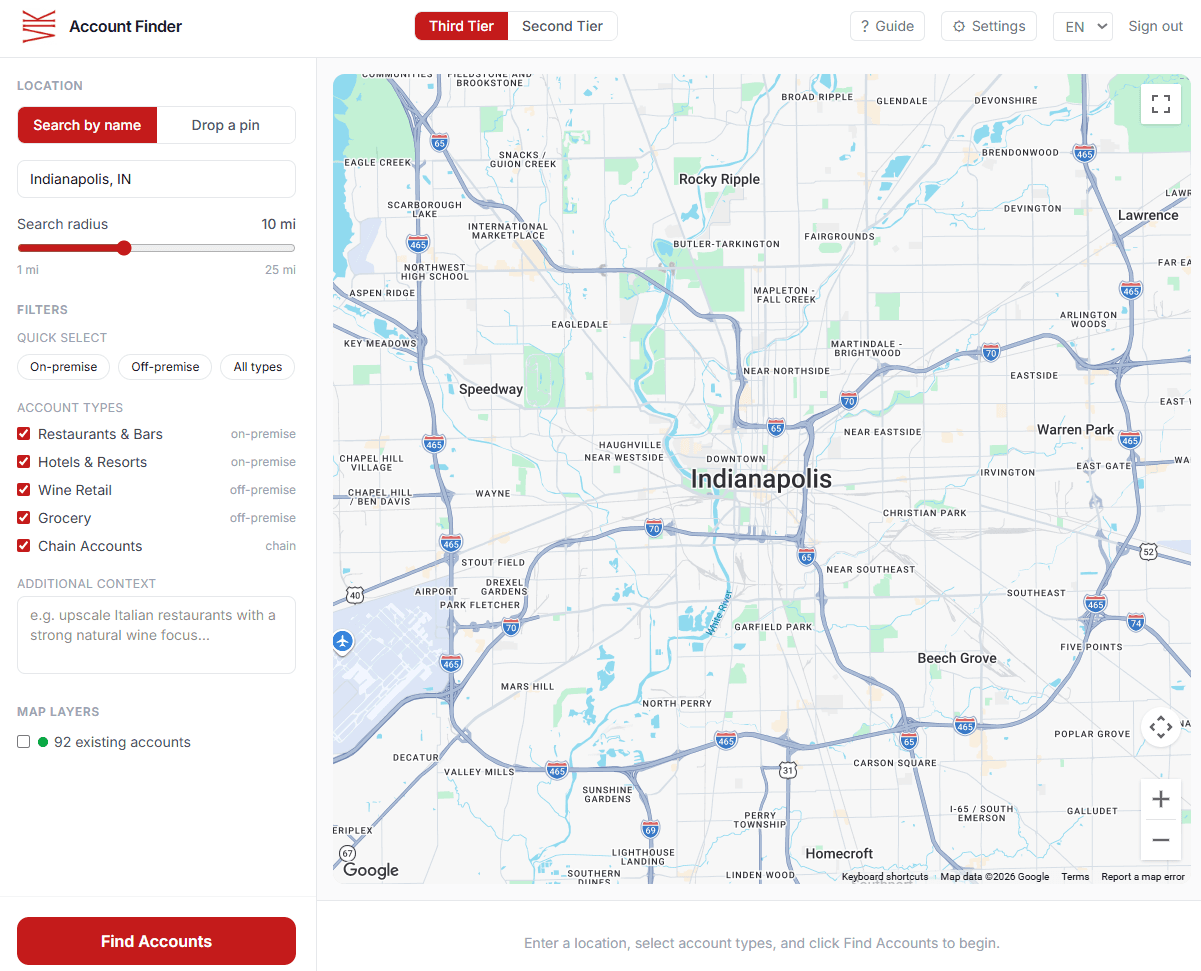
The Account Finder
Surfaces and prioritises the distributors and resellers worth your time in each market, so outreach starts with a shortlist worth working.
See the tool →
Current, not remembered.
I am in the American market this week, not remembering it. I run US distribution for a premium imported wine brand, across national accounts spanning big-box retail, specialty independents, and marquee restaurant groups: distributor meetings, depletion reviews, price postings, national-account negotiation. That is where the practice gets its currency. What is being bought, what is being dropped, where the shelf and the by-the-glass list are moving. The specific accounts are the brand’s business, not mine to publish, so I keep those names off this site. What I bring here is the pattern behind it, and a weekly pass over US federal label approvals (TTB COLA) that shows who is entering the market and with what. Not a playbook from a few years ago. What is happening right now.
I also take keynotes, workshops, and teaching on US market entry and the cultural fluency the trade runs on, in English and French.
06 /Start here
First, something in writing. Then a call.
Tell me about your brand and where you want it to go in the US. A written diagnostic comes back first: where your price actually lands on an American shelf, the set it would compete with, and the questions worth settling before you spend. Then, if we both see a reason to, fifteen minutes on a call to walk through it. Neither costs anything and neither obligates you.
See a sample diagnostic (fictional producer, PDF) ↗And the calibre of a full engagement: a sample Channel Strategy Assessment on one page (fictional estate, PDF) ↗Deliberately small
I take on a small number of engagements at a time, by design. The work is hands-on and I do all of it myself, which is the point and also the limit. Every engagement has a defined scope and a fixed fee agreed before you commit. If the timing is not right, I will say so. And if what you need calls for a specialism beyond mine, I will point you to someone who has it.
See where your price lands.
The diagnostic costs you a form and gets you an answer in writing.